
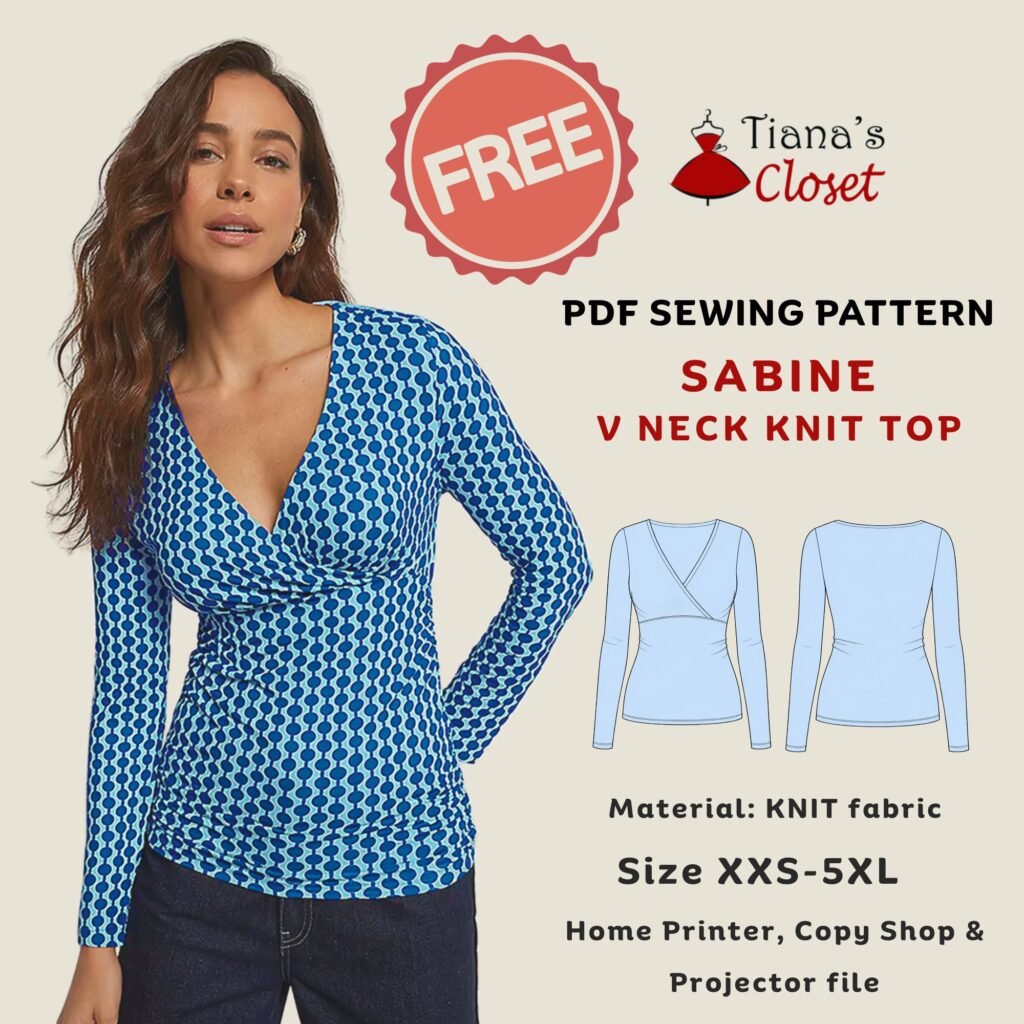
Transitional seasons are often the hardest to dress for. Mornings start cool, afternoons warm up quickly, and layering can easily go from comfortable to overwhelming. This is where a well-fitted long sleeve knit top becomes essential – light enough to stay comfortable, yet perfect for layering when needed.
The Sabine V-Neck Knit Top is designed with exactly this versatility in mind. With its flattering, body-hugging silhouette, elegant overlapping V-neckline, and clean long sleeves, it strikes the right balance between simplicity and sophistication. It pairs effortlessly with jeans, tailored pants, or skirts, making it a reliable piece for everyday wear. Add a blazer or jacket, and it transitions seamlessly through changing temperatures.
Despite its polished look, Sabine is beginner-friendly. If you are comfortable sewing with knit fabrics, you can complete this top in just an afternoon.


Pattern Details
- Sizes: XXS – 5XL
- Format: Layered PDF (A4/US Letter, A0, and Projector files included)
- Refer to the SIZE GUIDE and PRINTING GUIDE in the pattern or linked guide before printing
- Always print the test square first to confirm accurate scaling
Note: Some printers may not print true to size at 100%. Adjust scaling if needed (e.g., 103%) and verify with the test square.
SEWING INSTRUCTION
TOOLS AND MATERIAL
- Fabric of your choice. This pattern is intended for KNIT fabric. You can use cotton jersey, ribbed knit or cotton lycra or a variety of blends.
- Clear elastic/fusible stay tape to stabilize the seams.
- Scissors, pencil or fabric marker, ruler, pins
- Sewing machine/Serger or needle and thread
- Printed pattern
FABRIC REQUIREMENTS
You will need about 150cm (60”) of fabric for this project (fabric width 140cm/55”)
PATTERN PIECES
The pattern pieces are as follows:
- Upper Front: cut 2 mirrored pieces
- Lower Front: cut 1 piece on the fold
- Back: cut 1 piece on the fold
- Sleeve: cut 2 mirrored pieces
- Neck Binding: cut 1 piece
SEAM ALLOWANCE
- Hem: 2cm (3/4”)
- All other seams: 1cm (3/8”)
- Seam allowance has been included in the pattern pieces. Cut pattern as is and use the above-mentioned seam allowance when constructing the garment.
CUTTING INSTRUCTION
Place the pattern pieces on the fabric, pin the pattern pieces to the fabric to secure them in place. Using sharp scissors, carefully cut out the fabric pieces along the outer lines of the pattern. Take your time to ensure precise and clean cuts, as this will affect the fit and overall appearance of your garment.
Make sure to mark all notches and other design features such as darts, pleats, draw marks etc. from the pattern pieces onto your fabric. When sewing the garment, pay attention to notches, they must match up.
SEWING INSTRUCTION
1. Stabilize the edges
- Apply fusible stay tape on the wrong side of fabric, along the shoulder and the neckline seams of the garment to stabilize the fabric to prevent stretching.
- You can also use clear elastic to stabilize the seams.
2. Sew the Upper Front to the Back
- Place one Upper Front and the Back pieces right sides together, match the shoulder seam and stitch.
- Serge/zigzag stitch the seam allowances to finish the edge and press towards the back of the garment.
- Repeat to attach the other Upper Front piece to the Back piece.
3. Finish the neckline of the garment with binding
- Place Neckline Binding along the neckline of the garment, right sides facing. Gently stretch the neckline binding and pin it to the main fabric.
- Stitch the binding to the main fabric using 1cm (3/8”) seam allowance. Cut off the excess length of the binding if needed.
- Trim the seam allowances down to 0.5cm (1/4”).
- Fold the free end of the binding to the wrong side of the garment, so that the raw edge meets the neckline stitching. Fold the binding once again so that the binding is completely turned to the wrong side of the garment. Slightly roll the fold so that the binding is completely invisible from the right side. Pin.
- Edgestitch along the folded edge of the binding to finish the neckline. Try to keep a constant distance from the neckline edge for a clean finish.
4. Sew the Lower Front to the Upper Front
- Place two Upper Front pieces overlapping each other, so that the end of the neckline on one Upper Front piece matches the notch on the bottom edge of the other Upper Front piece. Baste.
- Place the Lower Front and the basted Upper Front right sides together, matching the notches.
- Stitch to attach the Lower Front to Upper Front.
- Serge/zigzag stitch the seam allowances to finish the edge and press towards the upper front of the garment.
5. Sew the sleeve to the main garment
- Place the Sleeve and main garment right sides together, match the notch on the sleeve cap with the shoulder seam, the single notch on the sleeve with the single notch on the front garment, the double notch on the sleeve with the double notch on the back garment. Pin.
- Stitch the sleeve to the main garment.
- Serge/zigzag stitch the seam allowances to finish the edge and press towards the sleeve.
6. Sew the side seam and sleeve seam
- Fold the main garment wrong side out and match the side seam on the front and back garment, and the sleeve seam. Make sure the ends of the armhole seam line up. Pin.
- Stitch the side seam and sleeve seam in one step, starting from the hem of the garment toward the armhole, then pivot fabric and continue to the sleeve seam.
- Serge/zigzag stitch the seam allowances to finish the edge and press towards the back of the garment.
7. Finish hem
- Fold the hem of the garment to the wrong side of fabric and press.
- Topstitch to finish the hem using double needle.
The Sabine top is designed to be both practical and refined. With clean construction and minimal pieces, it’s an efficient project that delivers a polished result. Once completed, it will quickly become a staple in your wardrobe – ideal for layering, styling, and everyday wear across seasons.
You can download the pattern from here: